
Dreamer
INFP
Introversion | Intuition | Feeling | Perceiving
Essence:
A personality type that perceives the world through the flow of time and inner imagery. Attention goes not only to what is happening but to how events unfold, how they connect, and where they might lead.
Reality registers as a process — with a direction, a mood, and an internal logic to its development.
Key Trait:
The most compassionate personality type — with a deep capacity to feel other people’s states, live them as one’s own, and respond through emotion: supporting, sharing the feeling, and genuinely being there.
Environment:
Thrives in a flexible environment with room for reflection, an inner rhythm, and gradual immersion in a process, free of rigid fixing and pressure on speed.
Can be drained by conditions demanding constant productivity, fast decisions, and clear metrics, and by anywhere personal values are ignored and there is no room for individual perception.
I — Introversion
Attention is directed inward — toward inner experience, sensation, and one’s personal reading of what is happening.
N — iNtuition
The focus falls on meanings, connections, and how events develop over time, rather than on the facts themselves.
F — Feeling
Perception passes through an inner response — what matters is what feels significant, close, and right.
P — Perceiving
A drive toward flexibility and freedom — no rigid fixing, with room to change decisions and direction as a situation develops.
For Dreamer (INFP), reality does not break into frames — it flows like a broad, endless river. This is not simply observing events but seeing the invisible threads that bind past and future into a single, meaningful pattern. Attention is always directed past the horizon: not toward what is happening in the moment but toward where it is all going and what it is becoming. That produces a remarkable sense of life’s wholeness, where every “now” is only part of a long and significant process.
In a world like that, reaction cannot be instantaneous. It resembles a photograph developing: an external event needs time to sink into inner quiet, grow there, and acquire clarity. Out of that pause comes an astonishing sensitivity — Dreamer feels the slightest change in an atmosphere or in someone’s mood on the skin. Dreamer’s own feelings are striking in their purity, with something almost childlike in them. If it is joy, it is total; if it is sorrow, it is bottomless — and both are lived through sincerely, with no attempt to adjust to anyone’s expectations.
This inner life seeks no hiding places; it flows outward naturally through words, gestures, and the very intonation of being present. There is no theatricality in it, only a need to be a conduit for one’s state. It is precisely why Dreamers are so convincing in creative work and in the art of language: they do not imitate emotion but transmit it from the depths. First comes the inner experience, and only then does it take form, allowing others to feel the world just as finely and vividly.
In everyday life this depth shows as unhurriedness. Dreamer has no wish to fix a choice or cut through a knot; what matters is leaving the space open so that understanding can ripen on its own.
In conditions demanding hard deadlines and dry results, things can feel cramped. External pressure forces this person to painfully gather themselves from within before taking a step. But wherever there is room for empathy and authenticity, the real gift unfolds — the ability to turn fine intuitions into a living reality everyone can feel.
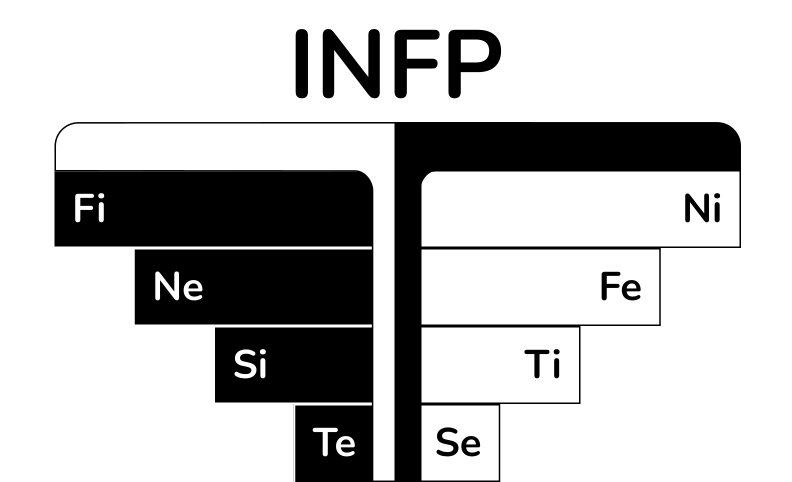 In Typeonics we view personality as a system of eight cognitive functions — ways of perceiving and processing information.
Everyone uses all eight, but each of us does so differently: some come naturally and easily, some switch on depending on the situation, and some take more effort.
What matters here is not only how well developed a cognitive function is, but how close it feels to you.
Some functions feel like your own — they hold your interest, you want to lean on them, and information that comes through them is taken in readily and with enthusiasm. We call these the Core Functions.
Other functions are not a priority: they may work perfectly well, but they usually switch on out of necessity and never feel like a natural place to stand. These are the Background Functions.
In your model these two groups are separated: one set covers what matters and interests you, the other covers what you tend to run on autopilot or ignore/avoid.
Below is the individual configuration of Dreamer’s (INFP) cognitive functions and how each of them shows up in life.
Core Functions
Superpower
Introverted Intuition (Ni / Time)
Dreamer’s (INFP) principal Superpower — Introverted Intuition (Ni) — is an inner compass tuned not to external facts but to the hidden logic of time. Reality does not scatter into random fragments here; it registers as a single thread running from the distant past into a future that has not yet arrived. Dreamer’s attention naturally holds that whole line in view, making it possible to see not merely the point marked “now” but the entire large process in its continuous movement.
Rather than getting bogged down in detail, Dreamer’s perception moves instantly to depth, piercing the outer layers of events. Everything superfluous and surface falls away, exposing the essence: the true cause, the hidden meaning, the direction of development. This understanding is rarely built brick by brick through logical analysis — it arrives as a sudden grasp of the truth. Inside, a complex process runs long and unnoticed, then flares into insight in a single moment. This is that wordless knowledge which needs no step-by-step proof — a whole, dimensional clarity that sometimes arrives as symbols, images, or metaphors.
Dreamer has a rare gift for sensing the future as an organic continuation of the present, reading tendencies already embedded in a situation but not yet visible to anyone else. This is not fantasy or guesswork but a fine recognition of which way the wind of change is blowing.
That intuition makes it possible to know in advance where a conversation will lead, or why a decision that looks logical at first glance will turn out to be a mistake over time. Attention works here as a filter, cutting away the secondary without mercy in favour of whatever genuinely shapes the outcome.
A particular place in this world belongs to an inner sense of rhythm. Time for Dreamer is not soulless numbers on a dial but a living, pulsing structure. There is an intuitive feel for when to hold still and let something ripen, and when the moment arrives that calls for a precise, decisive act.
In a rush that demands instant reactions, Dreamer feels uncomfortable, since this strength requires room to attune to a process. Yet it is precisely in that quiet, deep confidence that the main foundation lies: seeing past the horizon, sensing before others do, and knowing exactly where everything will finally arrive.
Tool
Extraverted Feeling (Fe / Emotions)
Where Introverted Intuition (Ni) gives Dreamer (INFP) a wordless depth, Extraverted Feeling (Fe) breathes life into it, making the invisible tangible for other people. It is a living bridge between the secret movements of the soul and the outer world: through voice, expression, and presence itself, inner states take form. Dreamer does not simply feel — Dreamer transmits, and does so not for an audience but by nature, as though that inner light inevitably asks to come out and fill the space.
Dreamer’s emotions are mobile and warm; they read easily in the eyes and in flowing intonation. There is a rare gift for hitting the right note, intuitively finding the true pitch of an exchange. This is not dry analysis but the finest attunement to another person: Dreamer hears not only the words but the pauses, catching the shades of mood that went unspoken. To that call a response arises almost instantly — a natural wish, coming from the heart, to warm someone, support them, or create the very atmosphere in which they can breathe more easily.
Dreamer’s expressiveness is remarkably precise, able to convey the subtlest nuance of experience with no excess strain but with a depth that disarms. This is where the magic of the creative work comes from: whether in text, music, or live speech, Dreamer does not imitate a feeling but lives it from the inside, making those meanings physically palpable to everyone around. That persuasiveness lies in authenticity, in the ability to turn a private disturbance into a shared act of feeling.
Openness of this kind, however, requires quiet and care. In an environment saturated with harshness, coldness, or strained tension, Dreamer is drained quickly. Someone else’s crudeness registers as a physical overload, forcing a withdrawal to heal the wounds and restore an inner order.
But wherever there is room for warmth, this gift unfolds at full strength. Extraverted Feeling becomes the instrument that turns the deep solitude of thought into living human connection, making the world around a little more real and a little more in tune with the soul.
Drive
Introverted Thinking (Ti / Structure)
Beneath all this depth of perception and sensitivity lies one more layer — less visible but very important. It is a drive toward inner clarity, toward having what is happening not only felt but understood. This is not about external logic or dry analysis. It is rather about internal construction: the wish for everything to add up — for sensation, understanding, and meaning not to contradict one another.
Dreamer (INFP) can stay in a state of reflection for a long time without necessarily showing it. Inside, a quiet work goes on: sorting, comparing, catching where something is imprecise, where it does not add up, where clarity is still missing. This shows as a drive toward purity of understanding. Not merely to feel something but to understand it — what it means, how it is built, what it rests on.
Sometimes this looks like an internal dialogue. Thoughts may return to the same point again and again, examined from different sides, until a sense arrives that everything has fallen into place. What matters here is less the result than the state of clarity itself. When things are clean inside, when there are no contradictions, a sense of support appears.
This cognitive function engages as an internal engine. It pushes toward not stopping at sensation but going deeper — toward understanding the structure of what is happening. Sometimes it can amplify doubt. When something does not come together, does not fit into a whole picture, internal tension arises — as though a little more time is needed to clarify everything.
Yet this is precisely where precision comes from. Not a surface precision but a deep one — where understanding has been built from within and admits no doubt. In everyday life this can show as a drive to get to the bottom of things: why does this work the way it does, what lies behind that decision, where is the logic here and how is it constructed.
None of this is always brought out into the open. More often it stays an internal process that simply makes perception more structured and more collected. Introverted Thinking (Ti) does not come to the foreground here, but it provides an important sense of support. It helps gather up what has been felt and turn it into clear understanding.
This is precisely why the function becomes a Drive — it leads gently but insistently toward internal precision, toward a state where everything is not only felt but understood.
Need
Extraverted Sensing (Se / Power)
Against the background of a bottomless inner world and a habit of living in the flow of time, a quiet but irresistible attraction to the other side of existence lives in Dreamer (INFP) — to reality in its most direct and tangible form.
It is a pull toward whatever can be seen, touched, and felt here and now: toward pure force, decisive action, and visible presence. This zone promises Dreamer (INFP) no easy confidence; on the contrary, it beckons precisely because it is unexplored, remaining territory where every step calls for particular courage.
Often that attraction takes the form of sincere admiration for people of action — those who move forward without hesitation, who can occupy a space and make decisions in the blink of an eye. Dreamer sees in them what sometimes feels missing: a firm footing on solid ground and the ability simply to go and do the thing.
This attraction produces an impulse to imitate, a wish to plunge into the world’s game abruptly and announce oneself at full voice, bypassing the long inner ripening. After a flare like that, however, a recoil often follows: action taken without inner resonance leaves only the feeling of an overstretched string, and fatigue. It is vital for Dreamer to ripen from within first before pouring outward.
Even so, this need for reality never subsides. It lives in a longing for vivid, sharp experience — in a wish to feel one’s own body, the taste of life, and the rhythm of physical movement more keenly. It is a search for a way back into the present moment not through reflection but through direct contact. Pressure is not tolerated here; the approach to the world of things and deeds must be gentle and gradual, with no violence done to one’s own fragile nature.
Over time this pull toward the earthly becomes a point of real growth for Dreamer. It is not an attempt at self-remaking but a great widening of boundaries, where inner depth finally joins with an outward gesture. At that moment an alchemy takes place: knowledge turns into action, and premonition into a tangible result. The inner world stops being only inner; it acquires flesh and a voice, allowing Dreamer not merely to contemplate life but to shape it confidently, as a co-author with reality itself.
Background Functions
Resource
Introverted Feeling (Fi / Relationships)
In the structure of Dreamer’s (INFP) personality, Introverted Feeling (Fi) is a powerful but unpublicised force. Unlike outward emotionality, this function works deep under the hood. It governs an internal ethical system, a fine understanding of human nature, and of how people genuinely regard one another.
For Dreamer this faculty is not a topic for social conversation or endless analysis of relationships. There is no inclination to dwell at length on questions of closeness, discuss the nuances of who likes whom, or pick over what each person felt at a given moment. Although these layers of human interaction are seen with total clarity, Dreamer prefers to use that knowledge silently.
This is an expert level of perception that engages automatically: Dreamer simply knows how sincere a person is, what the real distance in a relationship amounts to, and whether genuine feeling stands behind attractive words.
That strength is used selectively and only when it is truly needed. It allows Dreamer to identify insiders and outsiders without error, register falseness instantly, and step away from a destructive contact in good time. None of this takes effort or long deliberation — the internal verdict is delivered at once. That confidence makes it unnecessary to spend energy on superfluous explanation: Dreamer simply acts on an internal reading of the situation.
Introverted Feeling also serves as a reliable regulator of boundaries. It allows Dreamer to hold an internal course and resist external pressure when it contradicts an inner sense of what is right. This is a quiet but unshakeable reliance on one’s own values, requiring no public defence.
This is precisely why Introverted Feeling becomes a Resource. It is a powerful, finely tuned instrument that is always to hand. Dreamer does not make relationships the centre of any rhetoric, but this ability to navigate people silently and accurately confers an enormous advantage in life, making it possible to build only genuinely good and deep connections.
Filter
Extraverted Intuition (Ne / Possibilities)
Extraverted Intuition (Ne) works in Dreamer (INFP) as a powerful but background radar. The fan of alternatives is seen perfectly well, along with the understanding that any situation holds many possible outcomes — yet there is no wish to remain permanently in that field of probabilities.
For Dreamer this cognitive function does not become a foundation; alternative readings can be caught and an idea unfolded in several directions, but holding attention on a multitude of options for long produces discomfort and a sense of losing the direction of travel.
When the options become too many, an internal loss of focus sets in, and this is exactly where the Filter engages. Dreamer instinctively begins limiting the excess, working to narrow the field of possibilities and return to one genuinely important direction.
This shows most vividly in contact with other people. When someone starts generating ideas excessively, jumping constantly from one “and we could also do it this way” to the next, it can produce a quiet irritation in Dreamer. What tires this person is not the ideas themselves but the absence of depth, focus, and logical completion in them. In situations like these, Dreamer begins gently regulating the surrounding space: cutting away the excess, returning the conversation to the substance, and proposing that everyone settle on one specific option rather than scattering into a multitude of accidental directions.
This regulating function helps preserve wholeness of perception and protects against overload from other people’s concepts. Extraverted Intuition is used in measured doses — only to widen the view in a dead end, after which Dreamer returns immediately to the familiar internal direction.
Ultimately this Filter protects what is most valuable to Dreamer — the capacity for deep immersion. Being in a state of endlessly sifting options feels unnatural, since focus on one genuinely significant meaning always matters more than quantitative variety.
Extraverted Intuition in this role guards that perception from chaos, making it possible to hold attention on what carries real value and preventing external possibilities from knocking this person off the chosen path.
Mask
Introverted Sensing (Si / Comfort)
Outwardly, Dreamer (INFP) often appears more collected, calmer, and more grounded than things feel on the inside. That impression is largely created by Introverted Sensing (Si) — a cognitive function that brings attention into the body, into sensation, into a basic level of comfort.
Through it comes a sensitivity to simple but very concrete things: warm or cold, ease or tension in a space, the taste of food, smells, the general state of the body. A drive appears to settle in — to find a comfortable position, establish a routine, and build an environment where one can breathe out and feel steady.
What matters, though, is that this is not the setting Dreamer lives in by default. It is rather a way of levelling oneself and one’s engagement with the world. When internal processes become too saturated, when emotions or thoughts go too deep, it is precisely through the body that a return to steadiness becomes possible. Feeling a foundation, lowering the overload, gathering oneself back into reality. In that sense Introverted Sensing becomes a kind of outer shell — a form through which one can be in the world without exposing all that inner depth at once.
Dreamer’s social adaptation happens through this cognitive function. It is easy to engage in the kinds of care that are legible and expected: creating comfort, feeding people, offering tea, making sure everyone is at ease.
If guests are coming, for instance, a natural wish appears to arrange everything so that they feel good: thinking through the food, the atmosphere, the details. Or at work — decorating a space, making it more alive, warmer, more human.
Through actions like these a legible, socially readable image takes shape: an attentive, caring person whose company is comfortable. And it is precisely through this that Dreamer finds it easier to fit into an environment.
Not through loud display or forceful self-assertion, but through creating a space in which both this person and everyone else feels well.
Excessive fixation on the body, on health, or on domestic comfort can be tiring, however. When attention is held too long on physical sensation, on routine, on getting one’s state right, it starts to register as a constraint. Because for Dreamer this is not the foundation but a supporting way of regulating oneself and one’s presence.
Introverted Sensing does not define the inner world here, but it helps that world avoid falling apart on contact with reality. It creates a sense of steadiness, returns one to the body, to the moment, to a simple here and now.
This is precisely why it becomes a Mask — not as something insincere but as a form through which Dreamer can be legible, collected, and adapted in the outer world, even when something far deeper is going on inside.
Trigger
Extraverted Thinking (Te / Actions)
There is a territory whose touch is almost always accompanied by internal tension for Dreamer (INFP) — the world of concrete actions, results, and external demands, where everything must be clear, well grounded, and efficient.
Extraverted Thinking (Te) rests on facts, on verifiable data, on what can be measured and proven. What matters here is that decisions work, that processes are built properly, that a result is achieved. This space values clarity, directness, the ability to say the essential thing and move straight to action.
It is precisely here that a sense of mismatch arises. As though the rules were set in a different logic — harder, more direct, less sensitive to an inner process.
When a decision must be made quickly on the basis of objective data rather than feeling, confusion or resistance can appear. Not because the capacity to understand is missing, but because the mode of thinking itself feels foreign — too dry, too detached from inner experience.
This is particularly noticeable in areas where structure and control matter.
Finance, calculation, planning, resource management, working with technology — everything requiring precision, system, and constant monitoring of effectiveness can produce tension.
Having to keep a budget, for instance, track expenses, work through figures, or make financial decisions can get postponed or provoke internal rejection. Not because it is unimportant but because it demands constant engagement with a logic of counting, comparing, and optimising that does not come naturally.
The same applies to technology. When a system needs working out, something needs configuring, or how it functions at the level of structure and instructions needs understanding, a sense of overload can arise, along with a wish to put it off.
Extraverted Thinking also implies directness of expression. Formulating clearly, arguing a case, defending a position, running a process, giving instructions — all of it can feel too hard-edged, as though it required stepping out of one’s natural gentleness.
In situations calling for organising others, distributing tasks, and monitoring delivery, internal discomfort can appear. Taking on that role is not always welcome, particularly when it requires pressure or firm coordination.
All of this reinforces a sense of having to act in a way that is not one’s own. As though one had to conform to an external system with no room in it for a pause, for living something through, for a decision to ripen internally.
This can show as postponing tasks, as difficulty starting or finishing anything requiring clear structure and a result, and as a drive to escape the pressure into a more alive and meaningful space.
Extraverted Thinking in those moments registers as an overload — an outer layer of demands laid over an inner process, disrupting its natural rhythm.
This is precisely why it becomes a Trigger — a zone where the need to be efficient, rational, and fast collides with a deep, unhurried mode of perception and produces tension, resistance, or a wish to withdraw.
Introversion (I)
Dreamer’s (INFP) main life goes on in the quiet of an inner world — where images are born, meanings ripen, and living states pulse.
That energy is directed inward, turning external reality into no more than a source of impressions that must be lived through and absorbed before they become comprehensible. Nothing that happens outside is taken on trust at once; it has to settle to the bottom of the soul, pass through the filters of feeling, and find its place in the general pattern of an inner cosmos.
Out of this comes a deep, almost sacred need for pauses. Solitude for Dreamer is not a whim but a means of survival, a chance to return to one’s own rhythm.
Even the brightest and warmest company eventually calls for a retreat into the shade, to gather oneself and recharge that internal battery. In those moments of quiet the most important work takes place: scattered attention returns to the channel of a single thought or experience, turning the chaos of external stimuli into clear awareness.
From the outside this can look like pensiveness, detachment, or slowness. It seems that Dreamer takes longer than others to engage with a process, or hesitates before a choice, when in fact this person is simply following a different beat — what matters is not merely to react but to feel the truth of a moment.
Dreamer’s Introversion (I) is not a closing off from the world but selectiveness and depth. This person can be remarkably engaged and emotional, yet that response always arises from an inner assent rather than from external necessity.
When the world starts demanding continuous action and bustle, Dreamer quickly loses touch with themselves and falls into a dull exhaustion. What is vital is a space where one can simply be, without answering requests from outside.
Because it is precisely out of that return to oneself — out of quiet and reflection — that everything else grows: the perceptiveness, the feeling, and that very ability to come out to people bringing real depth and light along.
Perceiving (P)
Life for Dreamer (INFP) is not a blueprint with measured lines but a living, breathing process that unfolds gradually. This person rarely forces themselves into rigid plans, preferring to leave room for manoeuvre and for chance illumination.
Any final fixing, where everything is settled down to the last detail and not open to revision, produces an internal constriction. It seems that a strict schedule loses the most important thing — the chance to feel how everything should actually come together.
There is no chaos in this reluctance to put a final full stop, but there is deep trust in the flow of life itself. Plans are only approximate bearings, easily adjusted when the inner compass points another way.
From the outside this can look like indecisiveness or a habit of putting things off, but behind it almost always stands a wait for internal accuracy. Dreamer does not avoid choosing but lets a situation ripen, allowing a decision to be not merely logical but genuinely right.
In a world of deadlines and rigid procedure, Dreamer often finds it hard to breathe. Having to act on a script written in advance with no right to deviate registers as violence against one’s own rhythm. In those moments life feels dry and too predictable, stripped of air and sincerity. But wherever flexibility survives, Dreamer flourishes, feeling genuinely alive when it becomes possible to keep step with a process, neither running ahead nor hurrying time along.
Freedom here means the chance not to rush to conclusions, watching as the true path gradually emerges from the fog of uncertainty — a path that resonates in the heart itself.
The main source of energy for Dreamer (INFP) is the chance to live, feel, and convey meaning. Work becomes genuinely engaging when it has depth in it — when it is possible not simply to carry out tasks but to immerse oneself, understand, live things through, and find an inner connection in them.
Processes carrying a sense of development and unfolding potential are particularly attractive. When something gradually comes together, takes form, gathers significance, and begins to live — whether an idea, a project, a story, or a human connection.
The chance to express one’s inner world outwardly plays an important part. It matters to Dreamer not only to feel and understand but to convey it — through words, images, voice, visual forms, atmosphere. When there is room for that expression, engagement deepens and the work itself begins to feel like a continuation of an inner process.
The emotional side carries great weight here. It matters enormously to Dreamer that the work find a live response in other people’s hearts. Equally, when work is dry, formal, or very monotonous and repetitive, interest gradually fades. Far more energy comes from tasks with living content in them — where it is possible to touch people, share experience, feel an atmosphere, and receive a response.
A sense of wholeness matters too. When work does not break into disconnected fragments but comes together as a single process with a logic, a direction, and an inner sense that this is mine.
Difficulties can arise where work demands constant rigid fixing, strict structure, and orientation solely toward results. When the priority is acting fast, deciding fast, and keeping a permanent focus on efficiency, fatigue and a drop in engagement can follow.
Work with no room for reflection and pauses is equally tiring.
When everything runs in a get-it-done-faster mode, with no chance to stop, feel, and make sense of things, a sense of falling out of sync with one’s inner state gradually sets in.
Tasks involving finance, calculation, rigid planning, or technical processes can be difficult for Dreamer. Not because they are impossible but because they demand constant engagement with a logic that feels less natural.
The best fit is an environment that values depth, sensitivity, and the ability to understand and convey a mood — where there is room for creativity, flexibility, and the gradual unfolding of one’s own potential.
Suitable fields
Dreamer can find a place across very different areas, particularly where the work involves meaning, emotion, and the inner world.
Creative work and the arts
- writing
- poetry
- music
- acting
- visual art
- photography
Psychology and working with people
- psychological counselling
- coaching
- helping practices
- working with emotional states
Communications and content
- content creation
- storytelling
- blogging
- working with text
Education and development
- teaching (particularly in a live, informal format)
- creating educational programmes
- work with personal development
Example professions
- psychologist
- writer
- screenwriter
- copywriter
- content creator
- actor
- musician
- art director
- teacher
- coach
- photographer
It is worth understanding that for Dreamer the field itself matters less than the chance to work in it deeply and in one’s own way. Even in a well-suited area, work may fail to give energy if it holds no room for meaning, self-expression, and an inner response.
Fields that can be draining
Things tend to be harder in work built entirely around efficiency, speed, and clear metrics, with no regard for an inner process.
For example:
- heavily regulated work
- work with constant deadlines and a high tempo
- work requiring a fast, accurate reaction with no time to think
- tasks involving constant calculation, finance, and strict accounting
- technical processes with no emotional or meaningful dimension
Under these conditions a sense can arise that the work runs against one’s inner rhythm, which gradually leads to fatigue and a loss of engagement.
Overall, it matters to Dreamer that work be not merely a job but a continuation of the inner world. When there is scope to feel, to understand, and to convey, engagement, energy, and a sense of fulfilment come through most vividly.
Closeness for Dreamer (INFP) is not simply another person’s presence nearby but a deep, almost mystical sharing of experience. Formally being together is not enough; what is sought is a genuine merging at the level of meanings and inner states.
Relationships here are built on the finest sensations: how it feels to breathe alongside someone, how transparent the silence between two people is, and whether there is a sincere, living correspondence in that contact. When this inner connection disappears, even the most impeccable outward picture of a relationship instantly loses all meaning.
With skin that has no filters, Dreamer reads a partner at a depth invisible to the ordinary eye, catching the slightest shadows in intonation, a barely perceptible cooling, or, on the contrary, a tentative impulse of warmth.
Someone else’s state never remains mere information here — it resonates inside, producing a sincere wish to warm that person, support them, and not leave them alone with their own silence. There is a great deal of real light in that participation, and it is also what makes Dreamer vulnerable.
In a romantic partnership, Dreamer particularly values the sense of a reliable foundation. Feeling a strength nearby that will help ground the ideas and nudge gently toward growth matters. This person flourishes when a partner becomes a wise ally in development, providing motivation to move forward but doing so without dictate or hard deadlines.
Dreamer needs neither an overseer with a schedule of achievements nor an over-protective parent, but a guide who gives an impulse toward movement while leaving enough air for that inner rhythm.
The surface glitter of social conversation and empty talk about nothing drain this person quickly. Dreamer is drawn irresistibly to people with whom shared meanings can be explored and private things shared. The inner world, though, opens not at once but cautiously, layer by layer, only once the space has proved safe.
In love, Dreamer often follows an inner ideal — an elevated image of what true closeness should be — and is sometimes bitterly hurt when crude reality fails to match that dream. Conflict and the need to be firm are difficult territory for this psychotype. Direct confrontation or a hard no comes at the cost of enormous effort.
Excessive analysis of feeling is equally hard to bear: when closeness is dissected and sorted into compartments, Dreamer experiences overload. What matters is that love keep room for pauses and silence, that a relationship not turn into work but stay a living process in which two people can simply be themselves.
Who tends to be easiest
- people who sense depth and are not afraid of it
- those who are emotionally warm but not intrusive
- cheerful people who are easy to get moving
- those who respect personal space and an inner rhythm
- people interested in meanings, development, the inner world
- calm, steady people who apply no pressure
- people with inner strength, confidence, and the capacity to act — beside them a sense of support and attraction appears
Where difficulties can arise
- people excessively oriented toward results and efficiency
- those too direct and hard-edged in how they communicate
- anywhere lacking emotional depth
- relationships where one is constantly boxed in
- those who go excessively into detail, meticulousness, and endless picking apart of processes, losing the sense of the whole
What helps a relationship grow
- a sense of safety and care
- room for gradual closeness
- sincerity without pressure
- the chance to talk about what matters, but without an overload of analysis
- respect for an inner rhythm and for sensitivity
In relationships Dreamer opens up slowly, but deeply.
And when a sense of real contact appears, it becomes a bond holding a great deal of warmth, meaning, and genuine closeness.
Dreamer (INFP) is a person of depth, subtlety, and inner process. What works best here is not pressure or speed but care, sincerity, and a sense of live contact.
Give it time
Decisions, reactions, and answers do not arise instantly here.
What matters is a space in which something can be lived through, made sense of, and only then responded to.
Without hurrying or demanding an answer on the spot, contact becomes far deeper and more precise.
Speak sincerely, but gently
Falseness and strain are read very quickly.
At the same time, sharpness and hardness can wound or push away.
What works best is honesty without pressure — where one can speak directly but with respect for the other person’s sensitivity.
Don’t overload with analysis of feelings
Depth matters, but excessive picking apart can be tiring.
Constant conversations about who felt what and why start generating tension over time.
Sometimes it is enough simply to be in contact, without trying to fix everything in words.
Respect personal space
The need for time alone is not distance from the relationship but a way of recovering and staying oneself.
When that space is given, the connection does not weaken — on the contrary, it grows steadier.
Keep the atmosphere warm
Dreamer is very sensitive to environment.
Tone, mood, surroundings — all of it affects the contact.
Wherever there is warmth, calm, and a sense of safety, this person opens up far more deeply.
Add support and certainty
Beside people who can act, make decisions, and hold a direction, a sense of steadiness appears.
Clarity and quiet confidence help Dreamer feel more assured and unfold that potential to the full.
What’s best avoided
- demands for fast decisions
- hard, sharp communication
- dismissing feelings and experiences
- constant analysis and picking apart of the relationship
- an overload of tasks, deadlines, and demands for efficiency
- retreating into endless detail and minutiae