
Organizer
ESTP
Extraversion | Sensing | Thinking | Perceiving
Essence:
A personality type that perceives the world through direct engagement with reality: through force, action, and control over what is happening. How a situation is built, where its points of leverage are, and exactly what needs doing to get a result all become clear quickly.
Key Trait:
The most decisive personality type. Able to get oriented in a situation instantly, construct its internal logic, and make precise, practical decisions on the spot.
Environment:
Thrives where there is movement, momentum, and a need to act: reacting fast, taking on responsibility, influencing the course of events, and seeing the result of one’s actions here and now.
Drained by an environment that requires staying in theory at length, weighing many options with no move to action, or going into subtle personal feelings and relationships that are hard to structure and clarify.
E — Extraversion
Energy is directed into the outer world — into action, engagement with reality, and influence over events.
S — Sensing
The focus falls on specifics, facts, and what is happening here and now, rather than on abstract ideas and theories.
T — Thinking
Decisions are made through logic, structure, and an understanding of how a situation is put together.
P — Perceiving
An orientation toward flexibility, speed of reaction, and the ability to act according to the situation rather than to a plan set in advance.
People of this psychotype perceive the world through direct contact with reality, through action and influence here and now. The surrounding setting is always a field of concrete tasks for Organizer (ESTP), something that can be changed, strengthened, or brought under control. Landing in new conditions, this person spends no time studying detached theory. An instant reading of the situation switches on instead: the balance of forces, the hidden vulnerabilities, and the points of maximum leverage through which the course of events can be effectively turned.
This perception is strictly ordered. A clear logic assembles itself almost immediately: the rules of the game, the structure of what is happening, and the mechanisms holding it all together. Organizer restores order not through abstract planning or long meetings but through direct action. A situation is not merely analysed — it is taken into active development. Through precise decisions and a firm placing of emphasis, chaos stabilises quickly and becomes manageable. This is not control for the sake of dominance but a rational drive to bring reality into working condition: remove the excess, strengthen what works, set a direction, and carry the process through to a comprehensible result.
This fusion of realism and logic produces a characteristic style: fast engagement, an instant decision, and an immediate move to action with no hesitation or delay. In working or stressful conditions Organizer operates at maximum composure. Where others lose their footing under uncertainty or pressure, this person concentrates completely. A crisis registers not as a threat but as a technical problem to be taken apart, reassembled, and brought to heel. In everyday life the approach works just as precisely: if a process is falling apart, it gets put back together; if something is broken, it gets fixed, with no superfluous discussion. Organizer is oriented exclusively toward tangible practical effect — does the scheme work in practice, and how productive is it?
Extended reasoning unsupported by concrete steps produces internal tension and a sense of time wasted. Similar difficulties can arise in human interaction when it lacks transparency. Navigating vague hints, things left unsaid, and hidden psychological nuances that are never stated directly is not easy for Organizer. Blurred modes of communication overload this perception, which is why directness and clarity are always valued. Ultimately, Organizer is a practitioner of a high order, able to find the point of leverage instantly and, through precise, measured action, move any destabilised situation into a working, effective, manageable state.
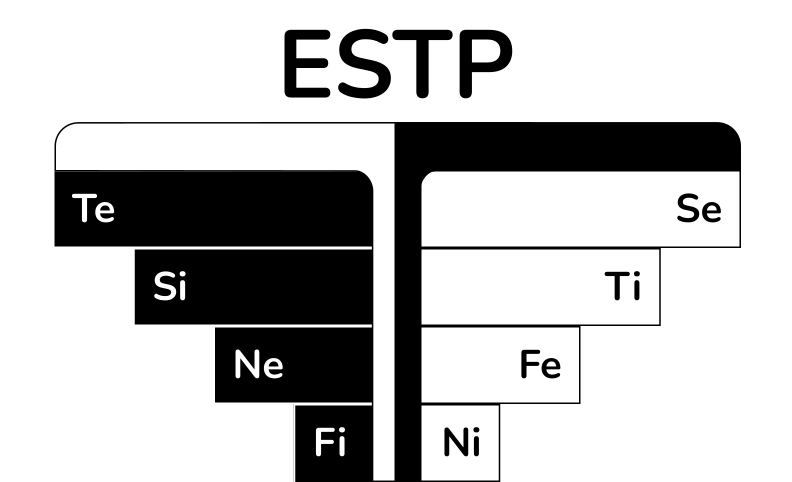 In Typeonics we view personality as a system of eight cognitive functions — ways of perceiving and processing information.
Everyone uses all eight, but each of us does so differently: some come naturally and easily, some switch on depending on the situation, and some take more effort.
What matters here is not only how well developed a cognitive function is, but how close it feels to you.
Some functions feel like your own — they hold your interest, you want to lean on them, and information that comes through them is taken in readily and with enthusiasm. We call these the Core Functions.
Other functions are not a priority: they may work perfectly well, but they usually switch on out of necessity and never feel like a natural place to stand. These are the Background Functions.
In your model these two groups are separated: one set covers what matters and interests you, the other covers what you tend to run on autopilot or ignore/avoid.
Below is the individual configuration of Organizer’s (ESTP) cognitive functions and how each of them shows up in life.
Core Functions
Superpower
Extraverted Sensing (Se / Power)
For Organizer (ESTP), the material world is not a frozen system but a dynamic environment for direct engagement, change, and influence. Attention is tightly focused on the present moment. Instead of detached interpretations or long-range assumptions, this person relies on concrete, tangible signals: who is doing what this second, where tension is building, which area needs reinforcing, and where a process is visibly starting to sag.
This practical realism is directly connected to a precise perception of physical space. Organizer registers the external characteristics of objects instantly: their dimensions, shape, density, distance, and relative position. Reality here is always structured, material, and clearly bounded. Any object is assessed not abstractly but from the standpoint of direct action — as an instrument, an obstacle, or a resource to be worked with.
A particular place in this coordinate grid belongs to reading status and the current balance of forces. Organizer identifies the centres of influence in any group or situation without error: who controls a process, who is giving ground, whose rules of the game currently dominate. Status here is not a formal line in a document but a real managerial resource. From this follows a natural drive to occupy strong, stable positions and to rule out vulnerable roles. It does not show as constant open hardness; what is at work is a firm internal principle: not to give up ground without solid reason, to hold boundaries clearly, and where necessary to build influence confidently in order to keep control of events.
Reality yields entirely to this influence. In new or stressful conditions Organizer’s attention does not scatter but on the contrary concentrates completely. A hard focus appears, along with composure and a readiness to engage. Between grasping a task and acting on it there is practically no pause. Waiting or drawn-out discussion registers as an ineffective loss of tempo.
Organizer restores order and coordinates processes directly in the course of the work, distributing tasks and resources on the move. Large, difficult challenges produce maximum engagement. Settling for little holds no appeal: wherever growth potential is visible, attention switches on automatically. Constraints or someone else’s formulations along the lines of “that’s impossible” rarely work as a stop signal — more often they register as a technical problem to be circumvented, reassembled, or solved another way.
The strength here lies not in chaotic activity but in precision of impulse — in the ability to strike at exactly the right point or make the right decision at exactly the right moment. Outward decisiveness and confidence feel entirely natural from the inside — a working state in which it is perfectly clear what is happening and how to reconfigure the situation for a specific task.
Tool
Introverted Thinking (Ti / Structure)
Introverted Thinking (Ti) governs an understanding of internal structure, of the connections between things, and of the principles on which systems are built. Where Organizer’s (ESTP) Superpower (Se) provides direct contact with reality, the Tool makes any external influence precise, well grounded, and applied. Faced with a complex task, Organizer breaks it into components instantly, identifying the rules of operation, the key nodes, and the vulnerable points. What is seen is not merely a direction in which to apply force but a specific technical algorithm guaranteed to deliver.
This function makes it possible to build an internal working model of a situation quickly. Even amid external chaos, a clear architecture of the process forms: which elements it consists of, how they connect, and where the critical point of influence lies. This is strictly pragmatic logic aimed at optimisation. Its purpose is to cut out superfluous steps, remove duplicated links, and reach the finish by the shortest route. Where others get lost in excess detail or give way to emotion, Organizer keeps a cool head, operating on facts and specifics alone.
An internal drive toward precision rules out acting blind. When a system or a process fails, Organizer identifies the logical error and eliminates it promptly. There is an ability here to spot weak points and miscalculations in other people’s plans or decisions instantly. This comes not from a wish to criticise but from a basic need for things to work precisely, with no unnecessary losses and at maximum return.
Paired with Extraverted Sensing (Se), Introverted Thinking (Ti) produces a powerful synergy: any action becomes measured, any influence targeted, and any decision tightly adapted to the specific task. Complex processes are deliberately simplified into transparent, working schemes, making that force entirely controllable and effective.
Drive
Extraverted Feeling (Fe / Emotions)
Extraverted Feeling (Fe) directs Organizer’s (ESTP) attention toward the external emotional side of reality: the general atmosphere, the dynamics of an interaction, and people’s visible reactions. This has nothing to do with analysing deep inner experience; the focus stays exclusively on overt signals — intonation, facial expression, level of tension or ease in an exchange. A live emotional background acts on Organizer as a powerful accelerator. In a charged, dynamic environment the tone rises instantly: decisions come faster and the tempo of action builds. Surroundings like these literally provide a charge and push this person toward active work.
Organizer reads the energy potential of a situation without error. When a process holds drive and movement, interest and a readiness to get into the middle of things arise at once. Sluggish, drawn-out formats with no external response, by contrast, produce irritation and a loss of concentration. This is why expressive, open people with animated faces and quick shifts of mood are naturally attractive here. Being around them works as a tactical recharge: external momentum reinforces one’s own composure, making practical tasks easier to carry out.
The emotional sphere is drawn on unevenly, though. Organizer can produce a powerful answering reaction and actively pull people in, but during dips in energy contacts get cut back pragmatically to conserve resources. Staying long in situations that require unpacking hidden psychological nuances or suppressed personal feelings is difficult. In those zones Organizer often finds too little to work with, since this attention is tuned from the outset to overt external signals rather than to hidden subtext.
Paired with the leading functions, the Drive produces a powerful impulse: the emotional charge of a space mobilises Organizer, turning atmosphere into an additional source of energy for confident forward movement.
Need
Introverted Intuition (Ni / Time)
Introverted Intuition (Ni) governs the perception of time, of how processes develop, and of where they finally arrive. For Organizer (ESTP) this territory is a zone of Need: it does not serve as a reliable foundation in its own right, but it produces a steady internal interest. How events distribute themselves across time is genuinely intriguing, yet holding focus on it for long without an external stimulus can be difficult.
This shows as a periodic interest in retrospect — analysing the cause-and-effect links of the past and identifying patterns. Large-scale processes can be attractive: the turning of historical eras, global shifts, the mechanisms by which one stage passes into another. Pragmatic questions arise about where a situation is heading, which factors were missed earlier, and what the present actions will finally add up to.
Abstract reflection on the future, however, quickly gives way to practice. Time horizons feel less concrete and less manageable to Organizer than the reality of here and now, so attention inevitably returns to the present moment. Long-range forecasting unaided, calculating precise deadlines, and waiting passively for the right moment all come hard. Decisions are frequently made before the full picture has formed, with an understanding of distant consequences assembled while already in motion.
For this reason Organizer feels a subconscious need for people who navigate temporal processes confidently. Such people register as valuable points of reference, able to reveal a hidden perspective, correct a direction in good time, and help with slowing down to assess a situation. Beside them it becomes easier to relate one’s current steps to the wider course of events. Combined with the leading functions, this Need produces a characteristic style: dynamic forward movement through concrete action, with the course corrected on the move.
Background Functions
Resource
Extraverted Thinking (Te / Actions)
Extraverted Thinking (Te) directs attention to the purely practical side of what is happening. The focus falls on actions that reliably produce a result, on real productivity, and on the shortest route to a goal. Organizer (ESTP) assesses a situation through external verification: how effective the steps are, what return they deliver, and whether the expenditure is justified by the final effect.
This function works as a powerful applied resource that activates as required. When a situation calls for engagement, composure appears instantly, along with a hard focus on the task and a readiness to act directly. Superfluous steps get cut away at once, with a clear sense of which solution will work fastest and most simply. That pragmatism rules out getting stuck at intermediate stages.
There is no drive here, however, to stay in efficiency mode for its own sake. Sustained concentration on dry metrics, on optimisation and endless improvement for the sake of process, becomes tiring over time when it lacks live momentum or a chance to influence a situation directly. Once a task is solved or loses relevance, attention switches to other goals. There is no internal need to bring everything to an abstract ideal — a tangible result always matters more than perfectionism.
This resource provides a reliable foundation in practical matters. It makes it possible to move instantly from grasping the essence of a problem to solving it physically, to assemble a process on the move, and to close tasks with no loss of time. Actions become not merely timely but concretely useful: the point of leverage is applied so as to deliver maximum real effect. The internal algorithm is entirely simple: if something needs doing, it gets done; if a goal has been set, it gets approached directly, with no complications.
Filter
Introverted Sensing (Si / Comfort)
This cognitive function governs the perception of the body’s physical state, level of comfort, and the quality of one’s surroundings. Attention here is directed inward — toward tracking fatigue, muscular tension, bodily rhythm, and the need for rest. Organizer (ESTP) handles this territory with reasonable confidence, yet the body’s signals rarely become a primary reference point when decisions are made. Focus on external action predominates, so physical discomfort often registers after the fact, once the overload has begun openly getting in the way of the process.
At the same time, Organizer retains a clear ability to assess external conditions: temperature, noise level, and lighting are all noticed, but the attitude toward them stays in the background, on the principle of whether it interferes with the task. When markers of discomfort become critical, the response is technical and fast: change the conditions, take a short pause to recover, and get straight back to work.
As a Filter, this function firmly cuts off any excessive preoccupation with comfort, one’s own or other people’s. A constant drive to choose the easiest, most pleasant route, or complaints about domestic inconvenience, register to Organizer as destructive factors that slow momentum. In any task, priority automatically goes to the result rather than to how one currently feels.
Regular rest and planned care of the body slip easily into second place when large, ambitious goals lie ahead. As a result, internal reserves can be spent faster than they are tracked. Organizer’s internal algorithm is autonomous: as long as physical condition is not obstructing movement, the process continues without stops. Introverted Sensing (Si) plays the role of a limiting safeguard — it does not set the direction of development but adjusts the load in good time, keeping questions of comfort from pulling focus off the main goal.
Mask
Extraverted Intuition (Ne / Possibilities)
This cognitive function governs the search for alternative approaches, unexpected ideas, and unconventional angles. In the structure of Organizer’s (ESTP) personality this territory is not a zone of basic confidence, so it is used mainly as a flexible social instrument for adapting quickly in a new context or creating the required impression.
In conversation this mode shows as situational resourcefulness and an ease on the fly. Organizer can pick up an unfamiliar subject quickly or propose an unconventional move to shift a stalled process. Since the function is auxiliary in character, ideas like these are usually aimed at solving the immediate problem and involve no deep development. They are fast tactical finds that help bypass an obvious dead end at a particular moment, not large-scale long-term concepts.
The options generated do not become an internal foundation. They arise easily and are discarded just as easily once practical testing shows them ineffective for reaching a specific result. This function serves as an external adaptive layer: it makes it possible to demonstrate flexibility of thinking and openness to alternatives when needed, while inside the familiar orientation toward real facts and actions remains.
Extended time spent endlessly sifting abstract options starts to tire Organizer. Detached reasoning and assumptions cut off from reality register as an irrational expenditure of energy. Once the need for an adaptive manoeuvre passes, Organizer naturally narrows the range of alternatives and returns the situation to a channel of comprehensible, manageable, tangible action.
Trigger
Introverted Feeling (Fi / Relationships)
This cognitive function governs the perception of personal relationships, inner attachments, psychological boundaries, and subjective values. For Organizer (ESTP) this territory is a Trigger — the zone of least confidence and of potential tension. Nuances of interaction that cannot be pinned down or verified by objective fact — hints, other people’s expectations, unspoken rules — often register as vague and lacking in substance.
Having to navigate subtle feelings or accommodate the hidden motives of others produces discomfort. In a working process, personal displays — grievances, demands for special treatment, a search for double meanings — create internal friction. They shift focus from a comprehensible task onto territory that is hard to manage. Building deep closeness step by step according to unspoken rules costs Organizer considerable energy, which is why a natural drive arises to make any interaction as direct, transparent, and predictable as possible.
The territory of human relationships nonetheless does not leave Organizer indifferent. With no stable internal foundation in this area, a sensitivity to other people’s assessments can show: whether the words came out correctly and whether anyone’s boundaries were accidentally crossed. To release the tension that arises from this uncertainty, Organizer works to close the ambiguous emotional layer quickly and return to a familiar format of action, logic, and measurable results.
This arrangement of the personality is not a deficiency but an important element of the psychotype’s overall balance. It is precisely this setting that keeps Organizer from getting stuck in doubt, from trying to please everyone at once, and that allows a firm hold on the main goal. Where excessive attention to other people’s feelings might slow a process, Organizer retains the capacity to make decisions promptly, take on responsibility, and lead. The talent for building processes effectively, managing people, and achieving success is directly connected to an ability to concentrate on the work rather than on attempts to account for the full range of individual expectations. This makes Organizer a practitioner able to take any situation under control and drive a process confidently forward.
Extraversion (E)
Organizer’s (ESTP) energy is directed entirely into the outer world — toward wherever concrete tasks, large events, and current situations are unfolding. Resources and a high internal tone come not from speculative reflection but from direct contact with reality and active participation in what is happening. A characteristic feature of this psychotype is instant engagement through action. No lengthy preparation or artificial internal tuning is needed: simply being inside a situation mobilises the attention automatically. This shows most vividly in dynamic conditions that require making firm decisions on the move and reacting promptly to change.
A central role in this motivation belongs to the drive to influence. External processes register to Organizer as a movable environment that can and should be acted on: changing the direction of development, reinforcing what works, intervening decisively at the first sign of failure. The passive position of an onlooker quickly becomes oppressive and registers as a restriction on what is possible — a natural impulse always fires to become a direct participant and a driving force in the process.
External feedback is a critically important source of energy here. People’s reactions, visible changes in the structure of a piece of work, a tangible interim result — all these markers confirm that things are moving and let Organizer adjust course right in the moment. This extraversion is broader than a mere need for interpersonal contact, though. Strength flows from the fact of managing processes: from having something to be responsible for, to build, to scale. Productive work with hard tasks and physical space provides just as much of a charge as dense interaction with a team.
Organizer is naturally drawn to environments with high speed, tension, and constant movement. It is precisely under deadlines, with many variables to keep under firm control, that maximum composure and crystalline clarity of thought switch on. When external activity drops, a corresponding drop in tone follows.
An absence of challenges and stagnation in one’s affairs lower productivity and produce a sense of unrealised potential. Recovery comes not through complete isolation from the world but through a tactical change of rhythm: moving into a steadier mode while keeping contact with reality intact — without hard pressure, but with a clear sense that the process continues. Overall, Organizer’s extraversion is a fundamental way of existing through continuous participation, targeted action, and integration into the surrounding world.
Perceiving (P)
Organizer (ESTP) builds a life not around rigid schedules but around a continuous process of engagement with reality. Preserving freedom of manoeuvre is critical here, reacting promptly to change and adjusting action to the situation at hand. Firmly fixed schemes are not the goal — it is far more effective to watch how events develop and make decisions on current data rather than on templates drawn up in advance.
There is no chaos in this approach; what is at work is high tactical adaptability. A plan for Organizer is a flexible reference point rather than a firm obligation. When a situation changes or a better prospect opens up, the original algorithm gets adjusted on the fly. In daily life the day is sketched only in general outline: the focus of attention shifts calmly toward wherever a real necessity or a new opportunity is arising. Rigid frameworks and excessive fixing, by contrast, strip a process of flexibility and can register as a loss of control over the situation.
The mode closest to Organizer is one that allows instant acceleration, a change of direction when a strong option appears, or a complete reassembly of a plan around new inputs. All key decisions are made directly in the course of the work. There is no need to calculate every scenario speculatively in advance — it feels more natural to take a concrete step, assess how the environment responds, and correct the course immediately.
This style gives Organizer maximum speed and manoeuvrability, though it can create certain difficulties wherever a single unchanging scheme must be followed for a long time, or long-term agreements must be fixed firmly with no right of revision. The internal rhythm here is dynamic forward movement with constant micro-corrections, a reliance on the facts of reality, and a readiness to rebuild a course of action instantly for the sake of maximum effectiveness.
The main source of professional motivation for Organizer (ESTP) is the chance to act directly, influence the course of events, and see a tangible result from one’s decisions. What engages this person most are tasks requiring fast orientation in changing conditions, a readiness to take on responsibility, and an ability to build a process quickly so that it starts working. Monotonous work, rigid regulations, and static conditions reduce interest fast. Organizer needs momentum, a constant flow of new challenges, and the chance to steer an outcome directly.
The level of difficulty in a task determines the degree of engagement directly. Obstacles and crises hold no fear here but act as a powerful catalyst: under hard pressure, maximum concentration, composure, and appetite all switch on. Difficulties register not as a problem but as a natural, working part of the process. The chance to overcome resistance from the environment, strengthen one’s position, and come out of a situation on top provides additional motivation and a surge of energy.
Inseparable from this quality is a high adaptability to competitive environments. Rivalry, the need to defend one’s interests and fight for a place in the sun, are mobilising. It is precisely under open competition that this leadership potential unfolds fully: decisions come instantly, the drive intensifies, and actions become extremely precise. In an excessively calm and predictable atmosphere, by contrast, Organizer starts to feel bored, sensing that considerable resources are going unused.
For full realisation it is essential to occupy key positions where the final outcome depends directly on one’s decisions. The chance to allocate resources, coordinate processes, and respond promptly to changing inputs raises productivity noticeably. Scale matters no less: local tasks hold interest only over a short distance, whereas large projects open real room for expanding influence and growing. The optimal environment for Organizer is business, crisis management, or production — fields that value initiative, decisiveness, a capacity to take responsibility, and the ability to steer a situation in real time.
Suitable fields
Organizers can find a place across very different areas, particularly where there is momentum, responsibility, and a chance to influence the result.
Fields like these include:
Business and management
- entrepreneurship
- launching and growing projects
- operations management
- risk management
Sales and negotiation
- active sales
- negotiation processes
- partnership development
- working on major deals
Project and operational work
- project management
- process coordination
- organising team work
- launching and optimising processes
High-momentum fields
- the events industry
- logistics
- fast-paced service industries
- crisis management
Competitive, growth-oriented environments
- business environments
- commercial projects
- highly competitive markets
- scalable products and services
Across many of these fields, what counts is the ability to make decisions fast, take on responsibility, and build a process so that it delivers.
Example professions
- entrepreneur
- project director
- operations manager
- business development manager
- sales manager / account manager
- negotiator
- project producer
- crisis manager
For Organizer it is not only the format of the work that matters but the role itself.
It needs scale: room to operate, influence over processes, and a position that carries weight and standing.
Even within one and the same field, work can either unlock this potential or constrain it — depending on whether there is room for growth, influence, and strengthening one’s position.
Fields that can be draining
Things tend to be harder in areas where the work requires holding a static process for long periods, involves no decision-making, and limits any chance to influence a situation.
For example:
- monotonous, repetitive tasks
- heavily regulated work
- work with no right to initiative
- processes where the result does not depend on a person’s actions
- extended theoretical work with no practical application
- work focused mainly on feelings and subtle personal nuances
Under these conditions a sense of stagnation, lost control, and falling energy can set in.
Overall, a sense of movement, influence, and scale matters to Organizer. When work allows making decisions, managing processes, and seeing actions produce results, motivation and engagement come through most vividly.
For Organizer (ESTP), personal relationships rest on reliability, concrete deeds, and transparent interaction. As this person understands it, real closeness is proven through action rather than declarations of feeling: being there at a critical moment, taking on responsibility, lending a shoulder, and solving a problem promptly.
The key factor in a long-term partnership is mutual respect and a sense of inner strength. Organizer is drawn to self-sufficient partners with a solid inner core, people who can hold a position confidently while remaining alive, open, and emotionally engaged. Interaction works most easily wherever hidden motives, manipulation, and complicated psychological games are entirely absent. Directness, clarity, and honesty are valued here as the only reliable foundation for a durable bond, while vague hints and an expectation that one should work something out unaided produce nothing but a natural wish to withdraw.
The emotional side of a partnership matters, but mainly at an external, tangible level — through the shared tone, mood, and dynamics of an exchange. A live response, shared drive, and the ability to share energy give Organizer a real sense of contact. Conversely, having to analyse subtle emotional states constantly, dissect feelings, and accommodate a wealth of unspoken requirements is quickly tiring. When a partner goes deep into personal experience, it can be hard for Organizer to work out promptly which step is needed at that second: to offer emotional support, to give the person space, or to move straight to concrete action.
In relationships, momentum and shared development are essential to Organizer. Stasis, excessive predictability, and stagnation in an exchange lead to a gradual fading of interest. At the same time, respect for boundaries and personal space is deeply valued here, and the same approach is extended to a partner at the level of actual behaviour: no control where none is needed, no artificial restrictions, no psychological pressure. Ultimately, the ideal partnership for Organizer is a dependable one, filled with clean energy and the freedom to remain oneself without unnecessary complication.
Who tends to be easiest
People who:
- are direct and honest in conversation
- are emotionally alive, with reaction and energy
- are confident, with an inner core
- are not inclined toward excessive analysis of feelings
- can hold their own boundaries and respect other people’s
Where difficulties can arise
- people who expect to be understood without words
- a large volume of hidden expectations and hints
- relationships requiring constant discussion of feelings
- excessive sensitivity and readiness to take offence
- when contact becomes too static and loses its momentum
What helps a relationship grow
- open and direct communication
- clear expectations and agreements
- the presence of movement, shared tasks or goals
- respect for each other’s boundaries
- a balance between closeness and freedom
Organizer is a person of action, influence, and direct engagement with reality. Things are easiest here when everything is clear, honest, and to the point. This person engages fast, decides fast, and expects the same level of clarity and involvement from everyone else.
Speak directly
Open, specific communication works best.
No hints, nothing left unsaid, no expectation that it should be obvious anyway.
When something matters, it is better to say it outright. That saves time, lowers tension, and makes an interaction far more effective.
Hold your position
What earns respect is not agreement but internal steadiness.
If you have your own view, it can and should be voiced.
People who can hold a position and don’t crumble under pressure register as equal partners genuinely worth engaging with.
Keep moving
A sense of process and momentum matters to Organizer.
When things drag, stall, or hang in the air, irritation sets in quickly.
Better to move forward even when not everything is perfect than to stay in the discussion stage for long.
Don’t overload with feelings and relationship analysis
Personal experience matters, but long conversations about feelings, picking a relationship apart, and attempts to examine everything layer by layer can be tiring.
When an interaction turns into constant analysis — who felt what, who understood it how — it creates tension and produces a wish to withdraw.
It is far simpler with specifics: what is happening, what doesn’t work, and what can be done about it.
Don’t slow the process without reason
If there is a task, it matters that it keeps moving.
Excessive doubt, postponement, or retreating into discussion with no action can register as a loss of tempo.
Better to name the difficulty and look for a solution than to hang in uncertainty.
What’s best avoided
- hints instead of direct dialogue
- a passive position and avoidance of decisions
- attempts to apply pressure through emotion or grievance
- excessive slowness with no objective reason
- unclear expectations and unspoken rules
Things are easiest with Organizer when an interaction is built on clarity, strength, and movement.
Directness, engagement, and a readiness to act create the ground on which this person unfolds most fully.
And then this is someone with whom you can not only reach an agreement but genuinely move forward — fast, effectively, and with a result.